The dirham is experiencing a bout of depreciation unusual in both its magnitude and duration. Against the euro, the Moroccan currency has now posted several consecutive weeks of declines. The move against the dollar has also accelerated since mid-September.
The trend gathered further momentum in early October. As of October 5, the euro was trading at 11.1799 dirhams and the dollar at 9.9779 dirhams, according to Bank Al-Maghrib’s reference exchange rates. Since the beginning of August, the euro has appreciated by around 4.1% against the dirham, while the dollar has gained nearly 6.9%. The greenback was thus approaching the symbolic threshold of 10 dirhams, while the euro had moved firmly above 11 dirhams.
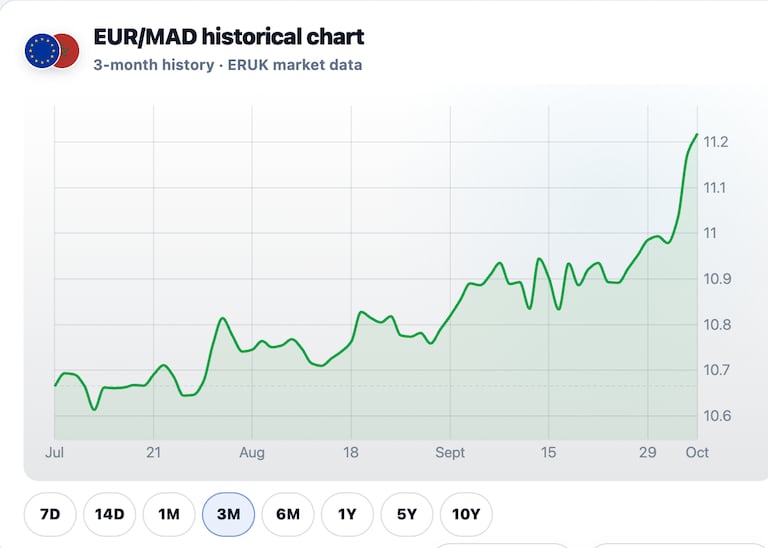
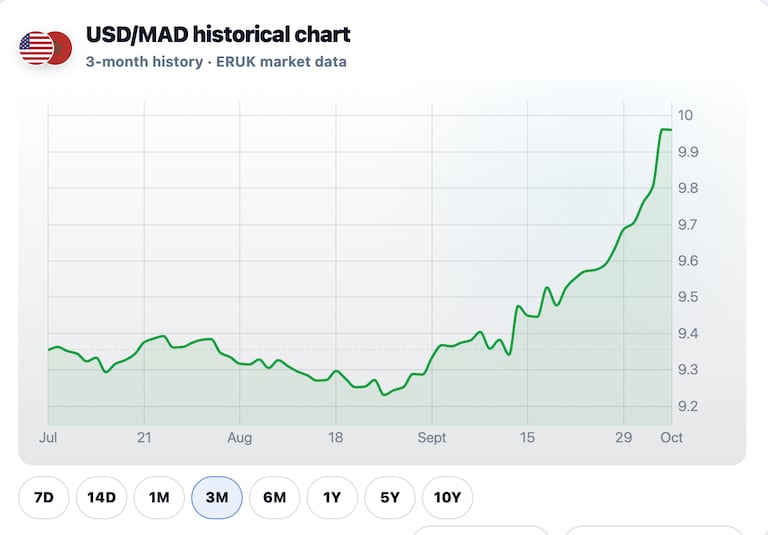
Is this simply a reflection of developments in international markets, or a sign of mounting pressure on Morocco’s external balances? The answer probably lies in a combination of the two. The dollar has strengthened on global markets in recent weeks, while movements in the euro and expectations for monetary policy at the world’s major central banks directly influence the leading currencies. In Morocco, however, the balance between foreign-currency supply and demand is also a key factor.
To understand the dirham’s movements, it is necessary to look at Morocco’s exchange-rate regime. The national currency trades within a ±5% fluctuation band around a central rate determined on the basis of a basket comprising 60% euro and 40% dollar. The dirham is therefore not a freely floating currency. Its movements remain constrained by this framework.
When the dollar strengthens on international markets, part of that appreciation feeds mechanically into the dollar-dirham exchange rate. The picture is more nuanced, however, when the dirham’s exchange rate against the euro is considered at the same time. The Moroccan currency can move differently against the two currencies depending on movements in the euro-dollar cross rate, but also on foreign-currency supply and demand in the domestic market.
It is on this second front that the latest data provide important insight. Over the first eight months of 2026, Morocco’s imports reached 617.5 billion dirhams, up 15.8%. Exports, meanwhile, stood at 334.9 billion dirhams. This left the country with a trade deficit of 282.6 billion dirhams, up 25.4% year on year.
The energy bill is one of the main drivers of this deterioration. Higher energy import requirements mechanically increase demand for the foreign currency needed to settle purchases from abroad.
At the same time, some of Morocco’s major sources of foreign-currency earnings have slowed. Exports of phosphates and derivatives were down 6% at the end of August. The decline was particularly pronounced in phosphate fertilizers, shipments of which fell 16% in the first half of the year.
Economist Abdelghani Youmni says these developments are unfolding against a geopolitical backdrop shaped in particular by the war between Iran and the United States and disruptions stemming from the closure of the Strait of Hormuz. In his view, these tensions have pushed up energy requirements and altered international trading conditions.
Youmni nevertheless stresses that the decline in phosphate and fertilizer exports cannot, on its own, account for the dirham’s depreciation. Morocco’s overall exports continue to grow, supported in particular by the automotive, aerospace, agriculture and agri-food industries.
The combination of sustained import growth and a weaker contribution from some export sectors is nonetheless putting additional pressure on foreign-currency flows.
The mechanism is relatively straightforward. Morocco continues to generate substantial foreign-currency receipts from exports of goods and services, tourism, remittances from Moroccans living abroad and foreign investment. At the same time, however, importers require increasing amounts of euros and dollars to pay for purchases from abroad.
When demand for foreign currency rises faster than supply, pressure can build in the foreign-exchange market. The widening trade deficit is therefore one factor that may help explain the dirham’s depreciation.
According to an analysis by Abdelghani Youmni, there is a raw 12-month correlation of around 0.64 between the trade deficit and the dollar-dirham/euro-dollar exchange rate. The economist says this statistical relationship points to a significant link between the deterioration in the external trade balance and exchange-rate movements, although correlation alone is not sufficient to establish a mechanical causal relationship.
For Youmni, the issue is therefore not a shortage of foreign currency or a speculative attack on the dirham. Morocco continues to benefit from substantial foreign-currency inflows from tourism, remittances from Moroccans living abroad and foreign investment.
The economist says foreign-exchange reserves, which stood at close to 500 billion dirhams at the end of August, provide a substantial buffer. Their level remains, in his words, “very comfortable.” At the end of July, reserves covered the equivalent of five months and 27 days of imports of goods and services, according to Bank Al-Maghrib.
“The decline in the dirham does not amount to a currency crisis,” Youmni stresses. According to the economist, there has been neither a collapse in reserves nor a speculative attack of the kind that has affected some emerging-market currencies.
At this stage, therefore, the dirham does not display the characteristics of a currency in crisis, such as the Argentine peso, the Egyptian pound or the Turkish lira.
That does not mean the depreciation is without consequences. Youmni identifies several channels through which it could feed through to the real economy.
The first is imported inflation. According to the economist, it could be “doubly imported.” On the one hand, higher commodity and energy prices resulting from geopolitical tensions raise import costs. On the other, Morocco faces higher costs for equipment, raw materials and intermediate inputs sourced from countries that are themselves experiencing inflationary pressures.
There is also the exchange-rate effect itself. As Youmni points out, a weaker domestic currency mechanically raises the dirham cost of goods and services priced in euros or dollars. Part of this shock can therefore ultimately pass through to domestic prices.
The depreciation also raises a monetary-policy question. If a weaker dirham contributes to inflationary pressures, Bank Al-Maghrib will have to balance several competing objectives.
For Youmni, the challenge lies in the trade-off between domestic monetary conditions and exchange-rate developments. The central bank must both monitor price pressures and take into account the risk that a prolonged depreciation of the dirham could itself become an additional channel for inflationary pass-through.
According to the economist, a sustained depreciation of the dirham could therefore make that policy trade-off more difficult.
External debt under scrutiny
Another transmission channel directly affects public finances and, in particular, external debt.
A portion of Morocco’s external debt is denominated in foreign currencies, notably euros and dollars. Any depreciation of the dirham therefore mechanically increases its dirham-denominated value.
For Youmni, this does not necessarily imply an immediate deterioration in solvency, but it can increase the cost of servicing or carrying that debt when measured in dirhams. The longer the depreciation persists, the greater the valuation effect becomes.
The equity market represents another transmission channel, although the impact could vary significantly from one company to another.
According to Youmni, exporters can benefit from a weaker dirham because revenues earned in euros or dollars translate into more dirhams when converted into the domestic currency. By contrast, companies heavily reliant on imports face higher input costs.
The economist believes the impact could be particularly pronounced for companies exposed to public procurement and dependent on imported equipment, raw materials or intermediate inputs. Higher costs could squeeze margins and, consequently, weigh on earnings and dividends.
These effects could, in turn, be reflected in the share prices of the companies concerned on the Casablanca Stock Exchange.
The real issue is how long the depreciation lasts
Ultimately, the central question is not simply why the dirham is depreciating, but whether the move will prove to be a temporary adjustment or become more persistent.
For Youmni, it is precisely the duration of the move that warrants attention. A prolonged energy crisis can push up imports, widen the trade deficit and increase demand for foreign currency. That pressure can contribute to further dirham depreciation, which can in turn raise import costs and feed inflation.
The main risk, therefore, is less an immediate currency crisis than the gradual emergence of a feedback loop between the energy bill, the trade deficit, the exchange rate and inflation.
The capacity of foreign-exchange reserves to absorb these pressures will be critical. As long as foreign-currency inflows from tourism, remittances from Moroccans living abroad, exports and investment are sufficient to keep reserves at comfortable levels, Morocco retains a substantial buffer against external shocks, according to Youmni.
The conclusion is therefore nuanced. The dirham’s current depreciation does not bear the hallmarks of a currency crisis. Rather, it reflects a combination of an adverse international environment, movements in the euro and the dollar, strong import growth and a weaker contribution from some major export sectors, particularly phosphates and fertilizers.
But the depreciation is not neutral. If the energy shock and geopolitical tensions persist, it could have consequences for inflation, the cost of external debt and corporate earnings, with differing repercussions across the economy and financial markets.