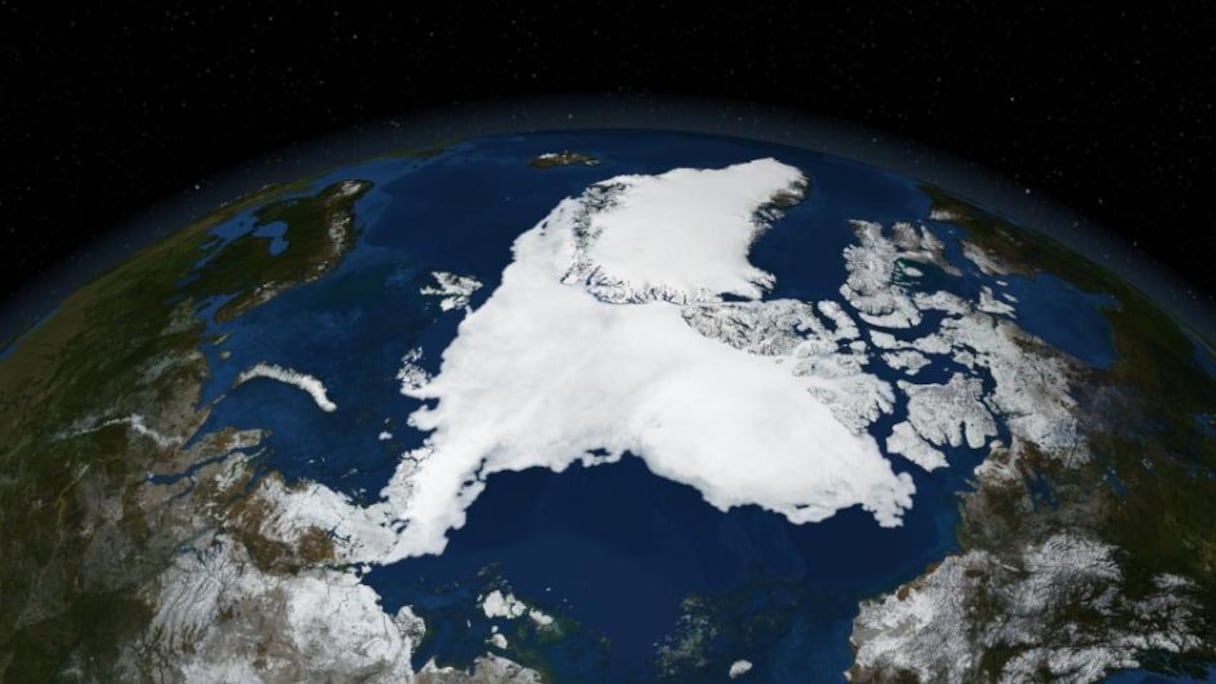
A new study by Christopher Kotsakis of Greece’s Aristotle University of Thessaloniki found that the rate of uplift at the poles roughly doubled between the late 1990s and 2015. The findings were published in the Journal of Geophysical Research: Solid Earth.
The changes mean that the solid Earth is becoming slightly less flattened. But its gravitational shape, known as the geoid, is becoming more flattened.
The apparent contradiction comes down to the difference between Earth’s rocky surface and the way mass is distributed across the planet.
Read also : Mediterranean Sea hits record 28.54°C as August heat breaks records
Earth is not a perfect sphere. Its rotation causes it to bulge slightly around the equator and flatten at the poles.
Kotsakis examined data from a global network of GNSS stations covering 1997 to 2015 to track tiny vertical movements in the solid Earth. Between 1997 and 2000, the polar regions were rising at about 0.5 millimeters per year. By 2015, the rate had reached roughly 1 millimeter per year. At the same time, the ground around the equator was sinking at an increasing rate.
Together, the two trends mean the solid Earth is becoming less flattened, with the poles rising and the equatorial region subsiding. But the geoid is behaving differently.
The geoid describes Earth’s gravitational shape based on how mass is distributed across the planet. As ice melts in Greenland, Antarctica and other polar regions, the ground beneath the ice loses weight and rebounds upward.
The meltwater then spreads through the oceans, adding mass at lower latitudes and increasing the weight on the seafloor.
That redistribution affects gravity differently from the physical movement of the crust. Moving mass away from the poles and toward lower latitudes makes the geoid more flattened even as the solid Earth becomes slightly rounder.
Kotsakis described the two trends as physically compatible despite appearing to move in opposite directions.
Read also : El Niño is back: How a warming Pacific could reshape the world
The study shows why measurements of Earth’s surface and gravitational field can tell different parts of the same story. The planet’s shape is being altered both by movements in its solid exterior and by the redistribution of mass across its surface.
The researchers linked at least part of the acceleration in polar uplift to melting ice, although the study examines the physical changes rather than treating ice loss as the sole driver.